
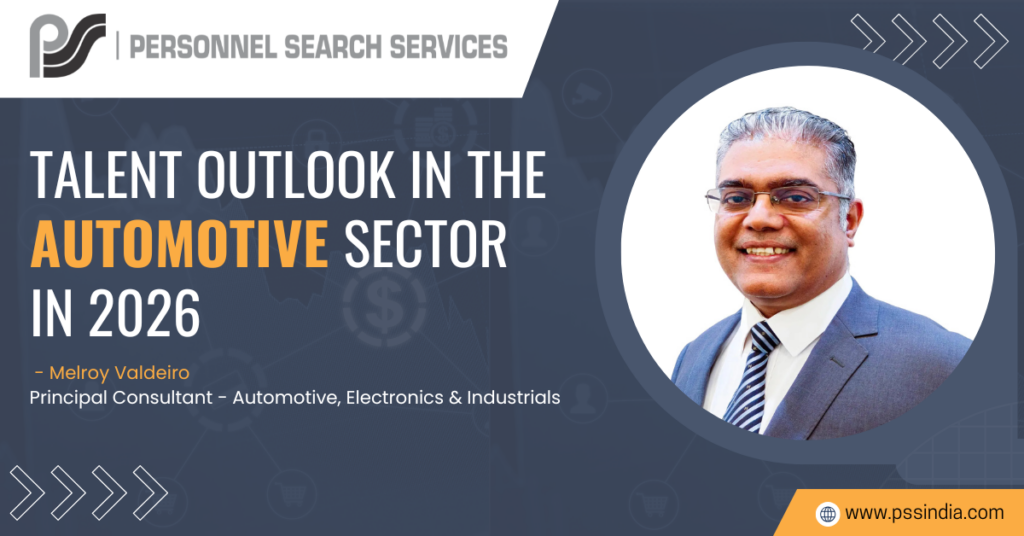
Known for his deep understanding of the automotive and broader manufacturing & industrials space, Melroy Valdeiro, Director – Industrials at Personnel Search Services, has extensive expertise in leadership hiring, market intelligence, and talent strategy.
With 20+ years of experience working closely with industry leaders and organizations, Melroy has developed a strong perspective on evolving leadership trends, business transformation, emerging skill requirements, and the future of talent. He shares his insights on the supply chain challenge in automotive and manufacturing due to the West Asia crisis, the pace of transition from ICE to EVs, the impact of AI in manufacturing, and evolving leadership skillsets shaping the automotive industry.
1) What are the key supply chain challenges due to the West Asia crisis currently affecting the automotive industry?
The West Asia crisis is pushing the automotive industry to prioritize supply chain resilience through localization, diversification of sourcing, energy transition initiatives, technology-driven monitoring systems, and more agile export and logistics strategies to remain globally competitive in response to the following challenges that have cropped up.
LPG shortages are forcing OEMs and suppliers to adopt extraordinary monitoring measures, including daily tracking across vendors.
Automotive component manufacturers are being compelled to reconfigure manufacturing processes by shifting from LPG to alternative energy sources such as electric heating, PNG (Piped Natural Gas), and renewables, while optimising gas consumption to reduce dependency and ensure continuity.
The crisis has triggered sharp inflation in critical raw materials used in vehicle production. Prices of steel, copper, aluminium, lithium, and noble metals have surged significantly, putting intense pressure on revenues, operating costs, and profit margins.
Freight and logistics costs have escalated substantially, with shipping rates increasing by 20–50% depending on routes. Shipping lines are rerouting vessels, transit times are increasing, and supply chain predictability has weakened.
Electric vehicle (EV), hybrid, and ICE production lines are especially vulnerable because many key components and materials either transit through West Asia or originate from nearby manufacturing hubs affected by geopolitical instability.

“The automotive industry is facing significant change as supply chain challenges and AI reshape the sector. Yet, these shifts are creating new opportunities. AI is enabling smarter vehicle design, improved operations,
and deeper customer insights, while driving demand for leaders who blend technical expertise, digital capabilities, and a people-first approach.”
– Melroy Valdeiro
2) What is your view on the pace of transition from Internal Combustion Engine (ICE) vehicles to Electric Vehicles (EVs)?
India’s transition from ICE vehicles to EVs is accelerating steadily, with EV sales rising approximately 25% year-on-year in FY26 to 24.5 lakh units, reflecting growing consumer acceptance and market momentum.
Despite this growth, EV penetration remains relatively low, with EVs accounting for 8% of total vehicle sales in 2025, indicating that the industry is still far from the government’s ambitious target of 30% EV sales by 2030.
The pace of transition is uneven across vehicle categories. Electric two-wheelers and three-wheelers are witnessing strong adoption due to lower operating costs and predictable usage patterns, while passenger cars are growing more gradually and electric trucks remain at a very early stage.
High upfront purchase costs continue to be one of the biggest barriers slowing EV adoption. Although EVs are cheaper to operate and maintain over time, many Indian consumers remain highly price-sensitive and prioritize immediate affordability over long-term savings.
Infrastructure limitations—including inadequate charging networks, evolving ecosystem support, and supply chain dependencies—are restricting faster EV penetration and creating uncertainty for both consumers and manufacturers.
Consumer trust and awareness remain important soft barriers. Many buyers still have concerns regarding battery life, resale value, charging convenience, financing availability, and long-term reliability, leading to cautious adoption behaviour.
I believe the long-term outlook for EV growth in India remains positive due to strong policy support, increasing localisation efforts, industry scale-up, and rising investor interest. However, achieving large-scale transition from ICE vehicles to EVs will require continued improvements in affordability, charging infrastructure, financing access, and ecosystem maturity.
3) How is Artificial Intelligence impacting the automotive industry?
That’s an interesting question! Artificial Intelligence (AI) is transforming the automotive industry across the entire value chain, including supply chain management, manufacturing, predictive maintenance, connected mobility, autonomous driving, customer engagement, and electric vehicle (EV) performance optimisation.
AI is accelerating the development of autonomous and assisted driving technologies in India. Startups and OEMs are deploying AI-powered Advanced Driver Assistance Systems (ADAS) capable of handling complex Indian road conditions, moving progressively from driver assistance toward conditional automation.
Manufacturing operations are becoming increasingly smart and semi-autonomous through AI-driven Industrial IoT systems, robotic inspection, and predictive maintenance. Automotive companies have reported efficiency gains of 10–15%, while AI-based visual inspections have reduced production rework rates by nearly 30%.
AI-enabled predictive maintenance and real-time diagnostics are improving vehicle reliability and fleet efficiency. Telematics platforms can monitor vehicle and battery health continuously, helping reduce downtime and improve operational efficiency by 15–35%, especially in commercial and fleet operations.
Connected vehicles are evolving into software-defined mobility platforms offering personalised in-car experiences, adaptive infotainment, predictive servicing, and digital services. This is also shifting automotive business models from one-time vehicle sales toward recurring digital-service revenues.
AI is playing a critical role in EV ecosystem development through intelligent battery management systems (BMS), route optimisation, and fleet intelligence. Indian EV manufacturers are using AI to improve battery performance and potentially extend battery life by 10–20%.
Despite strong momentum, AI adoption faces challenges including infrastructure variability, fragmented data systems, high sensor and processor costs, cybersecurity risks, and skill gaps among smaller suppliers. However, government policies, startup collaborations, localisation initiatives, and Industry 4.0 integration are expected to position India as a major global hub for AI-driven automotive innovation by 2030.
4) What are some of the skillsets and industry experience that is becoming most relevant when hiring leadership-level candidates for the automotive industry in India today?
Leadership hiring in India’s automotive industry is increasingly prioritizing candidates with strong technology and software orientation, as the sector shifts from being hardware-centric to software-driven through connected vehicles, embedded systems, automation, and digital manufacturing.
Experience in Artificial Intelligence (AI), digital transformation, and smart manufacturing is becoming highly valuable. Companies are seeking leaders who can integrate AI into production, quality control, predictive maintenance, and operational decision-making to improve efficiency and innovation.
Leaders with expertise in software-defined vehicles, infotainment systems, connected mobility, ADAS, and customer-centric digital platforms are in high demand, as automobiles increasingly resemble technology ecosystems offering personalised user experiences.
Strategic leadership capability is becoming critical, particularly the ability to redesign operating models, workflows, and business processes around AI and automation rather than simply applying technology incrementally to existing systems.
Human-centric leadership skills are becoming a major differentiator. Organisations are looking for executives who can balance human judgment with automation, maintain ethical AI governance, manage accountability, and build organisational trust in AI-enabled environments.
Data governance and analytical capabilities are emerging as essential competencies. Automotive leaders are expected to understand data readiness, AI model reliability, cybersecurity risks, and the importance of maintaining “human-in-the-loop” oversight in safety-critical manufacturing and operational decisions.
Cross-functional and innovation-driven experience is increasingly valued, particularly among leaders who can collaborate across technology, manufacturing, mobility services, EV ecosystems, and digital platforms while driving reinvention, adaptability, and long-term transformation within automotive enterprises.
Visit our Insights page for the latest news and industry trends from the PSS and executive search world PSS Insights
Follow us on our LinkedIn Page for more updates:
#talentacquisition #executivesearch #talenttrends #recruitment #pssinsights #hrinsights