
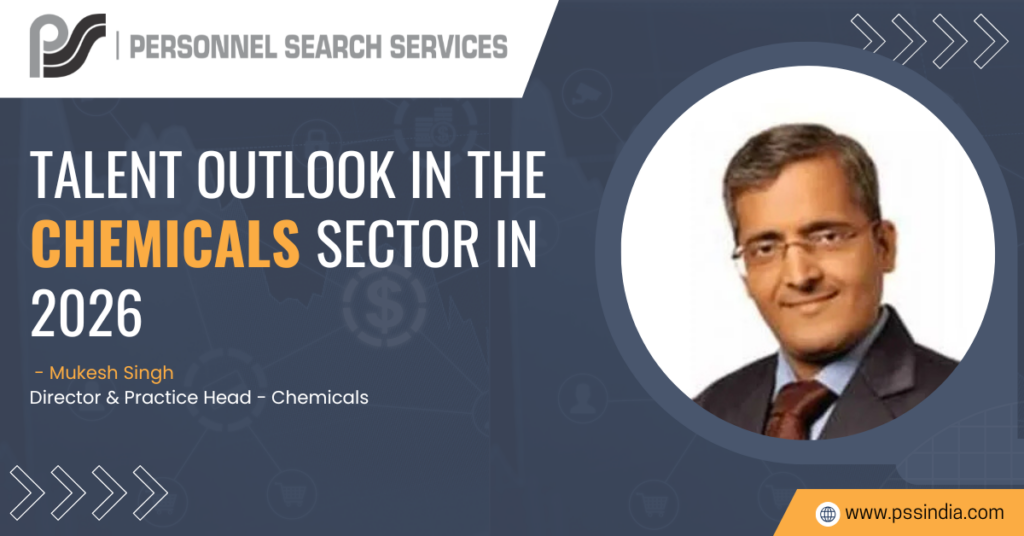
With a deep understanding of the chemicals and manufacturing industry, Mukesh Singh, Director & Practice Head – Chemicals & Manufacturing at Personnel Search Services, brings industry expertise and valuable insights into the evolving landscape of talent, leadership, and business transformation within the chemicals and performance materials sector.
Having worked closely with industry leaders and organizations, Mukesh has developed a strong understanding of emerging market trends, changing talent requirements, and the strategic priorities shaping the sector. In this blog, he shares his perspectives on the key growth areas expected to drive the chemicals industry over the next five years, including specialty chemicals, sustainability, digitalization, and global business development. He also highlights how Indian companies are positioning themselves as influential global players through innovation, strategic expansion, and a growing focus on value-added solutions.
1) With global supply chains moving away from China, how can chemicals (adhesives, polymers, performance materials) companies in India strategically position themselves to gain a larger global market share
India has the potential to significantly expand and even double its global market share over the next 5–7 years. However, this growth will depend on how effectively the country transforms its global positioning. For many years, India has largely been viewed as a low-cost manufacturing alternative to China, but the future opportunity lies far beyond cost competitiveness alone. To emerge as a stronger global player, India must build its reputation as a reliable, innovation-driven, and value-focused partner that consistently delivers high-quality and specialized solutions across industries.
By investing in innovation, advanced manufacturing capabilities, skilled talent, and long-term business relationships, India can move higher in the global value chain. Global companies today are not only looking for cost advantages, they are also seeking reliability, consistency, speed, specialized expertise, and trusted partnerships. If India continues to strengthen these areas, it has the potential to become a preferred global hub for innovation, manufacturing, and strategic business collaboration.
2) Findings suggest that the India chemicals industry may grow by 50% by 2030, do you agree? If yes, which key chemical segments are contributing to this growth? If not, why?
A 50% growth in India’s chemicals industry by 2030 appears achievable and is broadly in line with several industry estimates and market expectations. However, this level of growth is not guaranteed and will largely depend on how effectively India capitalizes on emerging global opportunities. The industry’s future growth will be driven by factors such as increasing exports, the rising demand for specialty chemicals, and the ongoing global shift in supply chains as companies look to diversify beyond traditional manufacturing hubs.
To sustain the momentum, India will need to strengthen its manufacturing capabilities, improve infrastructure, encourage innovation, maintain regulatory support, and build a strong reputation for reliability and quality in global markets. If these factors align successfully, India’s chemicals sector has the potential to emerge as a major global growth engine by 2030.
3) What kind of talent (technical, operational, or leadership) is most in demand within India’s chemical sector in 2026-2027?
Right now, India’s chemical industry is at a very interesting stage of growth. With the rapid rise of specialty chemicals, global supply chain shifts, and emerging sectors like EVs and electronics, the demand for skilled professionals is increasing across the industry. Companies are expanding their operations, setting up new capability centers, and investing more in innovation, sustainability, and advanced manufacturing practices.
At the same time, the industry is also facing a serious talent challenge. Despite the growing opportunities, there is an estimated shortage of nearly 30% in skilled professionals, especially in areas such as R&D, green chemistry, process engineering, and specialized manufacturing. As more global and domestic players scale their presence in India, the competition for experienced and industry-ready talent is becoming even stronger.
Over the next 2–3 years, hiring demand is expected to increase significantly as companies continue to strengthen domestic production, expand exports, and focus more on compliance, digital manufacturing, and innovation-led growth. However, one of the biggest concerns remains employability and workforce readiness. While India produces a large number of graduates every year, many candidates still lack practical exposure and hands-on industry skills. Because of this, organizations are increasingly investing in upskilling, technical training, and stronger industry-academia collaboration to build a future-ready workforce capable of supporting the industry’s long-term growth.
Visit our Insights page for the latest news and industry trends from the PSS and executive search world PSS Insights
Follow us on our LinkedIn Page for more updates:
#talentacquisition #executivesearch #talenttrends #recruitment #pssinsights #hrinsights