
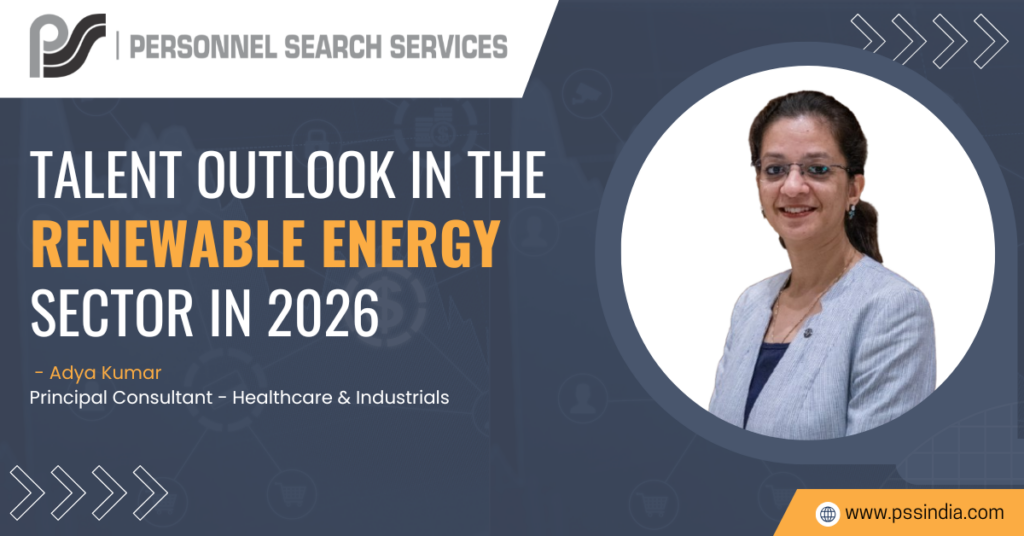
Adya Kumar, Principal Consultant – Industrial & Energy at Personnel Search Services Group, brings extensive experience in leadership hiring across Renewable Energy, Green Energy, Automotive, Manufacturing, and Environment-focused sectors.
With a deep understanding of industry dynamics and evolving talent requirements, Adya has partnered with organizations to identify leaders who drive growth, innovation, and operational excellence. In this interview, she shares her perspectives on emerging industry trends, critical leadership priorities, and the skills shaping the future of India’s industrial and energy landscape.
1. Which renewable energy segments are seeing the most investment in India? Who Is investing?
India’s renewable energy sector is currently seeing strong investment across solar energy, wind energy, green hydrogen, battery storage, and transmission infrastructure.
Solar continues to attract the highest investment, with nearly 44.6 GW of capacity added in FY26. Investors are actively backing utility-scale projects, rooftop solar, and solar manufacturing. Wind energy is also making a strong comeback, particularly with growing interest in offshore wind projects in Gujarat and Tamil Nadu.
Green hydrogen is emerging as the next big growth area, with companies like Reliance Industries, Adani Group, NTPC, and Indian Oil investing in hydrogen production, green ammonia, and decarbonization initiatives. At the same time, battery storage and grid infrastructure are becoming increasingly important as India expands its renewable energy capacity.
The sector is attracting capital from global investors such as KKR, Brookfield, BlackRock, Actis, and Macquarie, along with sovereign funds like GIC, ADIA, CPPIB, and Norfund. Leading Indian players including Adani Green Energy, Tata Power, JSW Energy, ReNew Energy Global, and NTPC Green Energy are also investing aggressively to expand their renewable portfolios.
Supported by government initiatives through MNRE, IREDA, and SECI, India is steadily moving beyond renewable power generation and building a complete clean-energy ecosystem that includes manufacturing, storage, transmission, and green hydrogen.

“India’s renewable energy sector is no longer just a capacity expansion story—it’s evolving into a complete energy transition economy. The next phase of growth will be driven not only by infrastructure but also by technology, climate finance, and innovation, positioning India as a global clean-energy manufacturing and technology hub.”
– Adya Kumar
2. Where are renewable companies sourcing talent from?
One of the most significant challenges facing India’s renewable energy sector today is the availability of skilled talent. There remains a considerable shortage of professionals with specialized expertise, particularly in emerging areas like battery energy storage systems (BESS), green hydrogen, grid integration, advanced manufacturing, and large-scale project execution. To address this talent gap, companies are increasingly recruiting foreign energy professionals from Europe, China, and Malaysia, and professionals from allied industries. A substantial portion of hiring is currently taking place from traditional sectors, including:
Oil & Gas: Primarily for leadership, strategy, and business development roles.
Thermal Power: For technical, operational, and plant management positions.
EPC and Infrastructure: Across project management, engineering, and execution functions.
Automotive and Manufacturing: Particularly for senior management and operational leadership roles.
Electrical Engineering Companies: To strengthen technical and engineering capabilities.
In parallel, the entry of global renewable energy players into the Indian market has intensified competition for talent. These organizations are bringing experienced professionals and expatriate talent with deep expertise in renewable technologies and project development.
3. What leadership roles and skillsets are in demand?
The renewable energy sector is seeing strong demand for leadership roles like Chief Sustainability Officer (CSO), Renewable Project Heads, Green Hydrogen Leads, ESG & Climate Finance Heads, and Battery Storage Directors.
Companies are mainly looking for technical skills in solar and wind energy, battery storage, grid integration, hydrogen technology, SCADA, smart grids, and AI-based maintenance systems.
At the same time, business-focused skills such as climate finance, carbon accounting, project finance, policy understanding, and stakeholder management are becoming equally important. Demand is particularly strong for professionals with experience in project development and execution, supply chain and procurement management, offshore wind energy, hydrogen technologies and Renewable energy operations and maintenance.
Technology is also reshaping the sector, with AI, data science, IoT, automation, and energy software playing a major role. That’s why many tech professionals are now moving into renewable energy companies.
4. Which regions in India will see the highest job growth?
India’s renewable energy sector is expected to see the strongest job growth in states like Gujarat, Rajasthan, Tamil Nadu, Karnataka, Andhra Pradesh, Telangana, and Maharashtra. Gujarat is currently India’s largest renewable energy state, with major investments happening in solar parks, wind projects, green hydrogen, and battery storage.
Rajasthan has become the country’s biggest solar power hub, thanks to large-scale solar projects and strong transmission infrastructure. Tamil Nadu continues to be a key player because of its strong wind energy ecosystem and turbine manufacturing industry, along with growing offshore wind opportunities. Telangana and Maharashtra are witnessing rising demand for talent in energy technology, battery storage, and renewable manufacturing. According to India Brand Equity Foundation, Rajasthan, Gujarat, Andhra Pradesh, Karnataka, Telangana, and Tamil Nadu are among the leading renewable energy hubs driving this growth.
5. How can India sustain its position as the world’s third-largest renewable energy market?
India has already emerged as one of the world’s leading renewable energy markets and has crossed 50% non-fossil fuel power capacity ahead of schedule. While this is a significant achievement, the focus now must shift from simply adding capacity to building a more resilient and sustainable energy ecosystem.
One of the key priorities will be strengthening grid infrastructure and expanding energy storage capacity. As solar and wind power are intermittent, investments in battery storage, transmission networks, and smart grid technologies will be essential to ensure reliable power supply. Another important area is domestic manufacturing. Reducing dependence on imports for solar equipment, batteries, and other critical components will be crucial for improving energy security and supporting long-term growth. Government initiatives such as the PLI schemes are important steps in this direction.
The sector will also require a much stronger talent pipeline. As renewable energy technologies become more advanced, there is growing demand for skilled professionals in areas such as energy storage, hydrogen, grid integration, and project execution. This highlights the need for greater industry-academia collaboration and focused training programs.
Looking ahead, emerging technologies such as green hydrogen, offshore wind, advanced battery storage, and AI-enabled energy management are expected to drive the next phase of growth. In my view, the opportunity for India extends far beyond renewable power generation. The country has the potential to become a global hub for clean energy manufacturing, innovation, and technology development.
Ultimately, India’s renewable energy sector is evolving into a broader energy transition ecosystem that combines infrastructure, manufacturing, technology, finance, and workforce development. The success of this transition will depend on how effectively these elements are integrated in the years ahead.
Visit our Insights page for the latest news and industry trends from the PSS and executive search world PSS Insights
Follow us on our LinkedIn Page for more updates: #talentacquisition #executivesearch #talenttrends #recruitment #pssinsights #hrinsights